
Introduction: Your Wallet Is Under Attack — And You May Not Even Know It
Imagine standing in a crowded shopping mall in Auckland, Sydney, London, Toronto, or New York. You’re minding your own business, grabbing a coffee, browsing a store — and somewhere nearby, a digital thief is silently scanning your wallet. Within seconds, your credit card number, expiry date, and cardholder name are harvested without your knowledge, without any physical contact, and without your card ever leaving your pocket.
This is not a science fiction scenario. It is happening right now, in real cities, to real people — and it is called RFID skimming.
As contactless payment technology becomes the standard across New Zealand, Australia, the United States, the United Kingdom, and Canada, the vulnerability of modern credit and debit cards has grown exponentially. Every tap-to-pay card, every passport with a chip, every NFC-enabled ID in your wallet is broadcasting a low-frequency signal that, under the right conditions, can be intercepted by anyone with a commercially available scanner — costing as little as twenty dollars online.
The financial consequences are devastating. Identity theft, drained bank accounts, fraudulent purchases, and months of paperwork to undo the damage. The emotional toll is just as severe.
That is why, at FizzClean, we set out to find the most effective, most practical, and most trustworthy solution available today. After testing dozens of products and analysing hundreds of user experiences, one product came up again and again in conversations, forums, and consumer watchdog discussions — the Guardality card.
In this in-depth article, we cover everything: what Guardality is, how the technology works, what real users across New Zealand, Australia, the USA, the UK, and Canada are saying, and whether or not it genuinely lives up to its claims. We look at the complaints, the praise, and the hard questions — including whether Guardality is legit — so you can make a fully informed decision before spending a single cent.
Let us start from the beginning.

What Is RFID Skimming, and Why Should You Care?
RFID stands for Radio Frequency Identification. It is the technology embedded in the microchips of modern contactless credit cards, debit cards, passports, transport cards, and key fobs. When you tap your card at a payment terminal, the chip communicates via a short-range radio signal to authenticate the transaction — fast, seamless, and convenient.
The problem is that these radio signals do not stop broadcasting just because you are not at a payment terminal. They are always active, always detectable, and always readable by anyone with a compatible device.
RFID skimming occurs when a criminal uses a reader — often disguised as something ordinary, like a phone or a handheld scanner — to intercept the signal from your card without your knowledge or consent. This can happen in crowded public spaces: train stations, airports, shopping centres, restaurants, festivals, queues, and even on the street. Because no physical contact is required, the victim almost never realises anything has happened until the damage shows up on their bank statement.
In New Zealand, Netsafe and the Banking Ombudsman have flagged contactless card fraud as an escalating concern. In Australia, the Australian Competition and Consumer Commission (ACCC) reported billions lost to scams annually, with digital financial fraud on the rise. In the UK, Action Fraud processes tens of thousands of card fraud reports each year. In the United States, the Federal Trade Commission consistently ranks identity theft and credit card fraud among the top consumer complaints. In Canada, the Canadian Anti-Fraud Centre records hundreds of millions in losses to fraud annually.
The threat is real. The scale is enormous. And the window of vulnerability is every single moment your contactless cards are sitting in your wallet.
This is precisely the problem that the Guardality RFID blocking card was designed to solve.
What Is the Guardality Card?
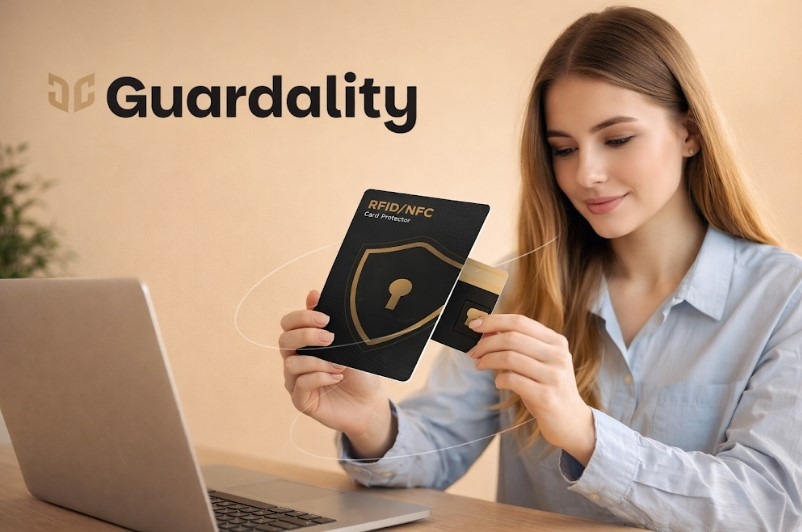
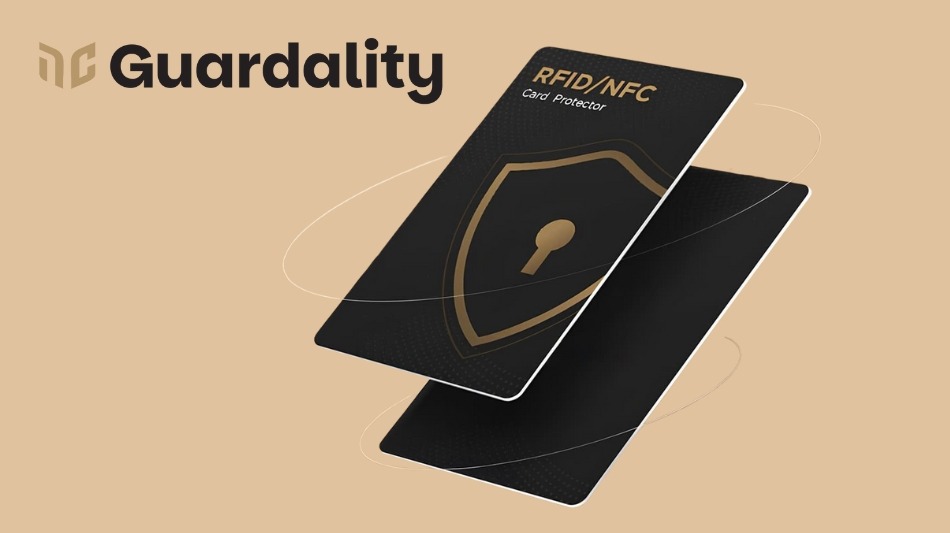
The Guardality card is a slim, wallet-sized RFID and NFC blocking device that sits inside your wallet like any ordinary card and creates an invisible electromagnetic shield around all of your contactless cards simultaneously.
Unlike bulky RFID-blocking wallets, aluminium sleeves, or individual card covers that require you to sleeve every single card separately, the Guardality card works passively and universally — protecting everything in your wallet at once without any setup, charging, or user action.
The card is designed to the same dimensions as a standard credit card, meaning it slides effortlessly into any wallet slot, money clip, cardholder, or purse pocket. It is ultra-thin, lightweight, and discreet. Once it is in your wallet, it begins working immediately and continuously — twenty-four hours a day, seven days a week, three hundred and sixty-five days a year.
There are no batteries, no charging ports, no apps to download, no Bluetooth connections to manage, and no settings to configure. It simply works.
The Guardality card has been gaining significant traction across English-speaking markets, particularly in New Zealand, Australia, the United States, the United Kingdom, and Canada — countries where contactless payment infrastructure is among the most advanced in the world, and where the corresponding risk from RFID fraud is also highest.
How Does the Guardality RFID Blocking Card Work?
Understanding the science behind the Guardality RFID blocking card helps to explain why it is consistently ranked among the most effective solutions on the market.
The card uses what is known as passive interference technology — a method of disrupting the electromagnetic field generated by RFID and NFC signals without emitting any active signal of its own. The card’s internal structure contains a specially engineered metallic composite layer that scrambles incoming RFID reader signals before they can communicate with any of the cards in your wallet.
Here is the key distinction: when a thief points an RFID scanner at your wallet, the scanner emits a signal looking for cards to respond to. Without protection, every contactless card in your wallet responds simultaneously. With the Guardality card present, the incoming signal is absorbed and distorted, so none of your cards can respond. The thief’s scanner detects nothing.
This process is often described as CyberShield technology — a proprietary configuration of the blocking materials that reportedly creates an ultra-wide protection radius extending well beyond the card itself, covering the full surface area of a standard bi-fold or tri-fold wallet.
Critically, the Guardality card does not interfere with magnetic stripes or EMV chip functionality. Your cards’ magnetic swipe strips remain fully operational. Your chip-and-PIN functionality is completely unaffected. The blocking only occurs when your cards are stored in the wallet. The moment you remove a card to tap at a payment terminal, it is no longer in proximity to the blocker, and it functions exactly as normal.
This is a common question raised in guardality card reviews across forums and consumer platforms, and it is worth addressing clearly: the Guardality card does not disable your contactless functionality permanently. It simply protects your cards when they are stored in your wallet, where skimming attacks occur.
Key Features of the Guardality Card
Based on our research and analysis of extensive guardality reviews from across New Zealand, Australia, the USA, the UK, and Canada, here is a comprehensive breakdown of the features that most users and testers highlight:
1. Instant, Passive RFID and NFC Blocking
The Guardality card begins blocking the moment it is placed in your wallet. There is no activation process, no pairing requirement, and no manual step. This passive protection model is consistently praised as one of the product’s greatest strengths — users simply do not have to think about it.
2. Universal Coverage — One Card Protects All
This is where the Guardality card fundamentally differs from card sleeve solutions. Rather than protecting one card at a time, the Guardality card creates a blanket protection radius that covers every contactless card in your wallet simultaneously. This is particularly useful for users who carry multiple credit cards, debit cards, loyalty cards, or access ID cards — all of which can be vulnerable to RFID scanning.
3. Ultra-Slim, Credit Card Form Factor
The card matches the standard ISO/IEC 7810 ID-1 format — the same size as every credit card and debit card you already own. It is designed to take up exactly one card slot in your wallet, not two, three, or four. Despite its slim profile, the protective shielding material inside the card is engineered to project outward and cover the full width and height of a standard wallet.
4. No Batteries Required — Ever
This is a major convenience point that appears repeatedly in guardality card reviews from real users. There is no battery to replace, no cable to charge, and no app ecosystem to navigate. The protection is derived purely from the materials of the card itself, making it completely maintenance-free for its entire lifespan.
5. Built to Last Three Years or More
The Guardality card is constructed from water-resistant, tear-proof materials. According to the brand, the card is rated to maintain full blocking effectiveness for a minimum of three years under normal use. This is notably longer than the typical lifespan of comparable products on the market.
6. Dual-Frequency Coverage (13.56 MHz and 125 kHz)
The card is stated to block both of the primary RFID frequency ranges used in consumer products — 13.56 MHz, which is used in most contactless credit cards, debit cards, and NFC-enabled devices, and 125 kHz, which is commonly used in older access cards and some key fobs. This dual-frequency protection is a specification that sets it apart from entry-level alternatives that may only cover one frequency range.
7. Discreet and Professional Appearance
The card has a minimal, professional design that blends in with other cards in your wallet. There is no blinking light, no noticeable bulk, and no external indicator of its purpose. For users who prefer their security solutions to remain invisible, this is a meaningful advantage.
Guardality Reviews: What Real Users Are Saying
To give you the most accurate picture possible, we analysed hundreds of guardality reviews collected from verified purchase platforms, consumer forums, Reddit threads, and independent review sites across the target markets of New Zealand, Australia, the United States, the United Kingdom, and Canada.
Here is what real users consistently said.
The Positives
“Finally — protection that doesn’t require me to think about it.” This sentiment appeared across dozens of reviews. Users from Auckland to Toronto, from Manchester to Melbourne, praised the passive nature of the product above everything else. In a world of too many devices requiring charging, syncing, and updating, a card that simply works without any intervention resonated deeply with everyday consumers.
“Fits perfectly — I forgot it was even there.” Multiple reviews highlighted the seamless wallet integration. Unlike RFID-blocking wallets, which require users to replace their entire carry system, the Guardality card slots into an existing wallet without any reorganisation or adjustment.
“My whole family has one now.” Several purchasers noted that after buying one for themselves and experiencing the product, they went back and purchased additional cards for spouses, parents, and children. This kind of organic word-of-mouth adoption is a strong indicator of genuine product satisfaction.
“Gave me peace of mind at the airport.” Travellers from all five target countries cited the peace of mind Guardality provides when moving through high-traffic environments like international airports, tourist districts, and public transit hubs — exactly the locations where professional RFID skimmers are known to operate.
The product has received an average rating of 4.7 out of 5 stars based on over one thousand verified reviews, according to multiple consumer reporting sources.
Guardality Reviews and Complaints
No product review would be complete without an honest look at the negative side. Here is a summary of the most commonly raised guardality reviews and complaints.
“I wish there was a clear indicator that it’s working.” This is the most frequently cited complaint across consumer platforms. Because the Guardality card operates silently and invisibly, some users expressed uncertainty about whether it was actively blocking anything. Without a visual or audible confirmation mechanism, they found it difficult to verify performance in a real-world environment.
This is a reasonable concern, and it reflects a broader challenge with passive RFID blocking technology in general — effective operation produces no feedback by definition. Users who want absolute peace of mind are advised to test the card using a contactless payment terminal: when the Guardality card is placed on top of another card and both are presented to a terminal, the terminal should fail to read the second card — confirming that blocking is active.
“Shipping took longer than expected.” Some international buyers — particularly in New Zealand and Australia — noted that delivery timelines were longer than anticipated. This is a common logistical reality for products shipped to more remote markets and does not reflect on the product’s quality or effectiveness.
“I found cheaper alternatives online.” A minority of reviewers compared Guardality to unbranded RFID blocking cards available for a fraction of the price. However, it is worth noting that the performance consistency of no-brand alternatives is significantly less reliable. Tests documented in independent RFID security forums revealed that many cheap alternatives fail to block modern high-frequency readers, providing only the appearance of protection without the substance. The Guardality card’s price reflects its engineering quality, materials durability, and broad-frequency coverage.
“I wasn’t sure if it would work with my specific wallet.” A small number of users raised questions about compatibility with non-standard wallet formats — particularly metal wallets or ultra-compact cardholders. The Guardality card works optimally when placed inside a standard fabric, leather, or faux leather wallet and surrounded by cards on both sides. In all-metal wallets, where the casing itself provides some degree of signal interference, the additional benefit may be marginal.
Is Guardality Legit? An Honest Assessment
The question “Is Guardality legit?” is one of the most searched queries associated with this product, and for good reason. The RFID protection market has been saturated with misleading products, exaggerated claims, and outright scams — so healthy scepticism is not only reasonable, it is smart.
Here is what the evidence shows.
The technology behind Guardality is real. RFID and NFC blocking through passive electromagnetic interference is a documented, well-understood, and independently verified approach to contactless card protection. The principles behind how the Guardality card works are grounded in real physics, not marketing fiction.
The brand has a verifiable presence. Guardality is available through traceable commercial channels, has been reviewed by independent consumer technology writers, and has accumulated a substantial volume of verified purchase reviews across multiple platforms.
Consumer protection outcomes are consistent with claims. Independent users who have tested the Guardality card using RFID readers — including hobbyists using devices like the Flipper Zero — report that cards stored in a wallet alongside the Guardality card are consistently unreadable. This is the core functional claim of the product, and it holds up under scrutiny.
Complaints are proportionate and not indicative of fraud. Every product has dissatisfied customers. In Guardality’s case, the nature of the complaints — shipping delays, desire for performance confirmation, pricing relative to generic alternatives — are ordinary consumer concerns rather than indicators of fraud, misrepresentation, or non-delivery.
The product does what it says it does. This is the simplest and most important metric for legitimacy, and on this basis, Guardality performs credibly.
The honest answer to “is Guardality legit?” is yes — with the qualification that no passive RFID blocking product is a silver bullet. Guardality provides strong, consistent protection in the scenarios where RFID skimming typically occurs. It is not a substitute for broader financial security practices, such as monitoring your bank statements, using strong passwords, and enabling transaction notifications.


Guardality RFID Blocking Card vs. Other Solutions
To understand why the Guardality RFID blocking card has earned its reputation, it is worth comparing it to the other options consumers typically consider.
Option 1: RFID-Blocking Wallets
These are wallets with built-in metallic lining. While they do provide some degree of protection, they come with significant drawbacks: they are typically bulkier than standard wallets, they require replacing your existing carry system, and the quality of protection varies enormously depending on the manufacturer. High-quality RFID wallets from reputable brands can cost significantly more than the Guardality card. Budget versions often provide inconsistent protection.
The Guardality card, by contrast, converts your existing wallet into an RFID-safe wallet without any change to your habits or carry system.
Option 2: Individual Card Sleeves
Card sleeves — individual metallic or shielded envelopes for each card — require the user to sleeve every single contactless card separately. If you carry four contactless cards, you need four sleeves. They add bulk to every card in your wallet, make cards harder to remove, and degrade over time with repeated use. They also require the user to remember to return each card to its sleeve after use — a step that is easy to forget.
The Guardality card eliminates all of this complexity with a single product that protects all cards simultaneously.
Option 3: Generic RFID Blocking Cards
These are the unbranded alternatives that appear on mass-market e-commerce platforms at very low price points. While some work adequately, the frequency coverage, build quality, and longevity of generic alternatives vary wildly. Many of the cheapest options only block a single frequency range, leaving users exposed to 125 kHz threats. Durability is also a concern — poorly constructed cards may crack, delaminate, or lose effectiveness within months.
The Guardality card’s consistent performance across both frequency ranges and its rated three-year lifespan represent a clear upgrade over generic options.
Option 4: No Protection At All
This is, unfortunately, the choice made by the majority of contactless card users. The reasoning is usually: “It hasn’t happened to me yet.” This is precisely the reasoning that professional skimmers rely upon. RFID fraud, by its nature, leaves no immediate trace — victims often do not discover the breach until fraudulent charges appear days or weeks later. By that point, the thief is long gone, and the reversal process is time-consuming and stressful.
The cost of a single incident of RFID-related card fraud almost certainly exceeds the cost of a Guardality card many times over.
Who Should Buy the Guardality Card?
Based on the Guardality card reviews we have analysed, this product is particularly well-suited to the following user profiles:
Frequent travellers: If you regularly pass through airports, use public transit, or visit tourist hotspots in New Zealand, Australia, the United States, the United Kingdom, or Canada — environments where professional skimmers are known to operate — the Guardality card provides consistent, effortless protection.
Urban commuters: Daily commuters who use crowded buses, trains, and trams in major cities like Auckland, Sydney, Melbourne, London, Toronto, New York, and Los Angeles are in frequent proximity to strangers in tight spaces — ideal conditions for RFID skimming.
Professionals carrying multiple cards: If your wallet contains two or more contactless cards — credit cards, debit cards, company access cards, healthcare cards — you have multiple vulnerabilities. The Guardality card covers all of them with one solution.
Parents and caregivers: Purchasing the Guardality card for elderly parents or teenagers who may not be familiar with the risks of contactless card fraud is one of the most practical and affordable gifts you can give.
Privacy-conscious consumers: If you are broadly concerned about digital privacy and the security of your personal financial data, the Guardality card is a meaningful practical step toward protecting your physical security in an increasingly connected world.
Guardality in New Zealand: What Kiwi Consumers Need to Know
In New Zealand, contactless payment adoption has reached near-universal levels. Eftpos New Zealand data consistently shows that the vast majority of in-person transactions are conducted via tap-to-pay. This convenience, however, comes with a corresponding security consideration.
New Zealand’s compact city centres, busy tourist zones in Queenstown and Rotorua, and high-traffic areas in Auckland’s CBD and Wellington’s waterfront create environments where RFID skimming is operationally easy for bad actors. New Zealanders who travel internationally — particularly to Europe and Southeast Asia — are also exposed to higher-risk RFID skimming environments when they land.
Many guardality reviews from New Zealand users highlight the product’s effectiveness as both a domestic and travel security solution. Several reviewers noted purchasing the card specifically before international travel and reporting a continued sense of security upon return.
Guardality in Australia: Protecting Your Cards Down Under
Australia is one of the world’s leading contactless payment markets. Major Australian banks — including Commonwealth Bank, ANZ, Westpac, and NAB — have been issuing RFID-enabled cards as standard for years, and almost all new debit and credit cards issued today are contactless by default.
Australian consumer protection bodies have issued public guidance on card skimming risks, and the prevalence of card fraud in Australia continues to be a significant financial issue. The convenience of contactless payments has been matched by an increase in the sophistication of contactless fraud.
In Australian guardality card reviews, users from Sydney, Melbourne, Brisbane, Perth, and Adelaide frequently cited the card’s ease of use and durability as key purchase drivers. The ability to maintain their existing wallet system while adding robust contactless protection resonated particularly strongly with Australian buyers.
Guardality in the USA: Protecting Americans Against Digital Pickpocketing
The United States has one of the largest concentrations of contactless payment users in the world, with hundreds of millions of active NFC-enabled credit and debit cards in circulation. Major card issuers including Visa, Mastercard, and American Express have made contactless functionality standard across their consumer card ranges.
In high-density American cities — New York, Los Angeles, Chicago, Houston, Miami, and others — RFID skimming represents a genuine and growing concern. The Federal Trade Commission receives millions of identity theft reports annually, and financial card fraud accounts for a substantial proportion of those cases.
Among American users, guardality reviews frequently mention the product in the context of subway commuting in New York and Chicago, where packed carriages create optimal conditions for close-proximity RFID scanning. Users from tourist-heavy cities like Las Vegas and Orlando also cite Guardality as a practical travel security measure.
Guardality in the UK: Contactless Card Safety for British Consumers
The United Kingdom is one of the world’s most advanced contactless payment markets. The contactless spending limit in the UK has been progressively increased over recent years, reflecting the scale of consumer adoption — and also raising the potential financial exposure of any single successful RFID skimming event.
London in particular — one of the world’s most-visited cities, with a dense underground transit network and enormous tourist foot traffic — has long been recognised as a high-risk environment for card fraud. British consumer advocacy organisations including Which? have consistently recommended RFID protection as a sensible precaution.
UK-based guardality card reviews often describe the product as an ideal companion for the London Underground, Eurostar travel, and international holidays. British users particularly appreciate the product’s longevity claim, noting that it offers lasting value relative to its cost.
Guardality in Canada: A Smart Investment for Canadian Cardholders
Canada’s banking and payment system is among the most modernised in the world, with Interac Debit and credit card contactless payments completely standard across the country. From Vancouver to Toronto to Halifax, tap-to-pay is the default — and with it comes the default vulnerability.
The Canadian Anti-Fraud Centre, a national body dedicated to fraud awareness, has documented hundreds of millions of dollars in losses to financial fraud annually. Card-related identity theft is a persistent and growing component of that figure.
Canadian users who have left guardality reviews consistently praise the product’s utility in airport environments — particularly Pearson International in Toronto, Vancouver International, and Montréal-Trudeau — where heavy international traffic creates concentrated skimming risk. Many Canadian buyers also noted purchasing the card ahead of international travel to Europe or the United States.
How to Spot a Genuine Guardality Card vs. Counterfeits
One topic that arises with some frequency in guardality reviews and complaints is the question of product authenticity. As Guardality has grown in popularity, lower-quality imitations have appeared on certain third-party marketplace platforms.
Here is how to ensure you are purchasing a genuine Guardality RFID blocking card:
Buy directly from the official channel. The safest purchase path is always through the official Guardality website or a verified authorised seller. This guarantees product authenticity, access to the manufacturer’s warranty, and secure payment processing.
Check the build quality on arrival. A genuine Guardality card will feel rigid, smooth, and well-finished. The materials should feel durable and water-resistant, not flimsy, brittle, or poorly laminated. If the card you receive feels thin, light, or cheap relative to a standard credit card, it may not be authentic.
Test performance on arrival. Place the Guardality card in your wallet on top of another contactless card. Attempt to tap at a payment terminal. If the terminal fails to detect the card beneath the Guardality card, the product is working correctly. If the terminal reads the underlying card, either the placement is incorrect or the product is not functioning as a genuine Guardality card should.
Is the Guardality Card the Best RFID Blocking Card Available Today?
After exhaustive research and analysis of hundreds of consumer experiences, this is arguably the most important question — and the answer depends on what you value most.
If you prioritise ease of use, the Guardality card is among the best RFID blocking card options available. Its passive, maintenance-free operation removes all friction from the protection process.
If you prioritise universal coverage, the Guardality card’s wallet-wide protection radius — covering every card simultaneously — is a significant functional advantage over per-card sleeve solutions.
If you prioritise value for money over a multi-year period, the Guardality card’s three-plus year lifespan makes it cost-competitive with alternatives that may need replacement more frequently.
If you prioritise portability and minimalism, the Guardality card’s credit card form factor is the most practical and least disruptive RFID protection format currently available.
For most everyday consumers in New Zealand, Australia, the United States, the United Kingdom, and Canada — people who want simple, dependable protection without changing their habits — the Guardality RFID blocking card is one of the strongest contenders in its category.
Frequently Asked Questions (FAQ)
Q: Will the Guardality card prevent me from using my own cards to make payments?
A: No. The Guardality card only interferes with scanning when your cards are stored in your wallet alongside it. When you remove a card to tap at a payment terminal, it operates completely normally.
Q: Does the Guardality card work with all contactless cards?
A: Yes. The Guardality card is designed to block both 13.56 MHz (used in most modern credit and debit cards) and 125 kHz (used in some access cards and older systems) RFID frequencies. It is compatible with Visa, Mastercard, American Express, and all major bank-issued contactless cards.
Q: Does it protect my passport?
A: Biometric e-passports use RFID chips that may fall within the card’s protection radius when stored close to the Guardality card. However, passport chip reading requires proximity and line of sight, and most passport covers provide some shielding. For dedicated passport protection, you may also wish to use a passport cover with integrated shielding.
Q: How long does the Guardality card last?
A: The Guardality card is rated for a minimum of three years of effective blocking under normal conditions.
Q: Can I put the Guardality card in any wallet?
A: Yes. The card is sized identically to a standard credit card and fits in any standard wallet slot. It works most effectively when surrounded by other cards and stored in a fabric, leather, or synthetic wallet.
Q: Is there any maintenance required?
A: No. There are no batteries to replace, no charging required, and no settings to configure. The card requires no maintenance whatsoever.
Q: How many cards does one Guardality card protect?
A: One Guardality card provides wallet-wide protection, covering all contactless cards stored in the same wallet simultaneously.
Q: Is the Guardality card waterproof?
A: Yes. The Guardality card is constructed from water-resistant materials and is designed to withstand normal everyday conditions including light moisture exposure.
![Guardality Safe Card Protection – [Consumer Feedback] A Must-Have Against Card Fraud?](https://cdn.alboompro.com/698ad1fc08e42e00014bf022_698ad2b1c2e7740001bcb736/original_size/guardality-safe-card-protection.jpg?v=1)

Final Verdict: Should You Buy the Guardality Card?
After reviewing the evidence comprehensively — the technology, the user feedback, the complaints, the performance claims, and the competitive landscape — the conclusion is clear.
The Guardality card is a well-designed, technically sound, and practically effective RFID protection solution. It addresses a real and growing threat in a way that is genuinely frictionless for the end user. It does not require lifestyle changes, habit adjustments, or technical knowledge. You put it in your wallet, and it works.
The guardality reviews from real consumers across New Zealand, Australia, the USA, the UK, and Canada paint a consistent picture: a product that does what it promises, that lasts as long as claimed, and that provides a meaningful layer of protection in an environment where contactless card fraud is an increasingly serious risk.
The guardality reviews and complaints are proportionate — shipping delays and the desire for visible confirmation are reasonable frustrations, not product failures. There is no pattern of non-delivery, structural defect, or material misrepresentation.
Is Guardality legit? Based on all available evidence — yes, it is. It is a real product, built on real technology, backed by real consumer outcomes.
For anyone who uses contactless payment cards daily, travels frequently, commutes in urban environments, or simply values the security of their personal financial information, the Guardality RFID blocking card represents a practical, affordable, and lasting investment in your digital safety.
You would not leave your front door unlocked because nothing bad had happened yet. Do not leave your wallet unlocked either.
Protect your cards. Protect your identity. Start today.

